Peleș Castle
A Neo-Renaissance royal residence at Sinaia, built 1873–83, with its own hydroelectric plant. Not medieval, and much more comfortable than anything that is.
- How long to allow
- Two hours
- Best for
- Interiors, and anyone tired of ruins
The background
Peleș is the most-photographed building in Romania and the one most often misdescribed. It is not a fortress and it is not old: the foundation stone was laid in 1873 and it was inaugurated in 1883, as a summer residence for Carol I, the country’s first king.
Its architecture is Neo-Renaissance with a heavy German-Alpine accent, and it was extended in phases up to 1914 by the architect Karel Liman. The royal family used it every summer until 1947.
Why the plumbing matters
Peleș was built at the point where a great house could be a technical exercise, and it was treated as one. It had electricity from 1884, supplied by its own hydroelectric plant on the Peleș stream, and central heating from 1897. It is routinely called the first castle in Europe to have either; the specifics are what we can check, and they are impressive without the superlative.
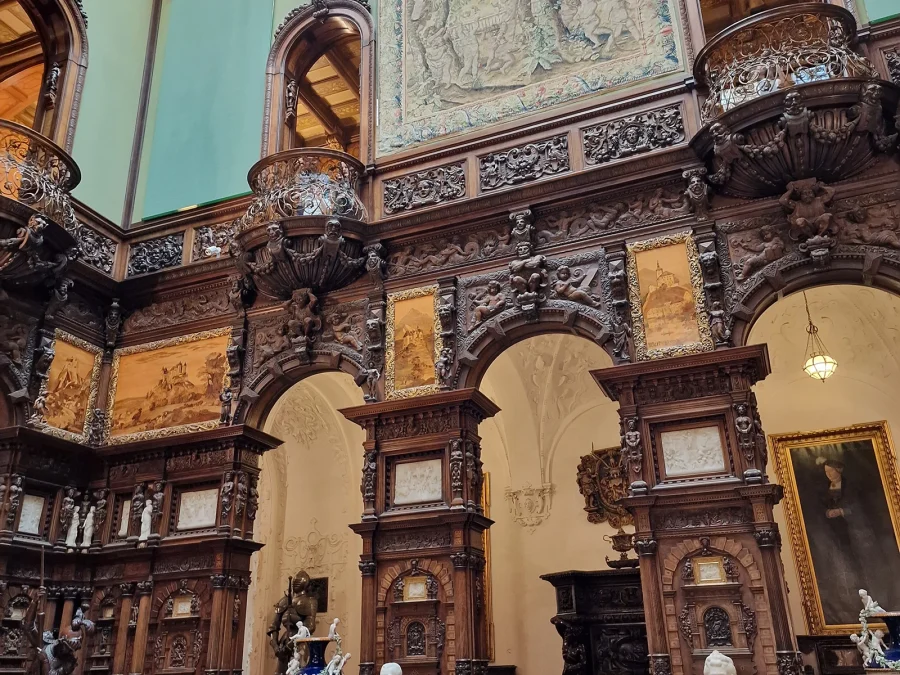
Look for it in the building rather than the placards: the central hall has a retractable glass ceiling, and there is a lift.
Where it is
Peleș is at Sinaia, in Prahova County — administratively Muntenia rather than Transylvania, though it sits on the main road up from Bucharest and is usually visited on the same trip as Brașov and Bran. The grounds are worth time in their own right, and Pelișor, the smaller house beside it, is quieter and to many tastes more likeable.
Opening times and tickets
We do not publish opening hours or prices, because they change and a wrong time here is worse than none. The operator keeps the current details.
Official websitePrefer to have the route organised for you?
Guided private trips and custom itineraries are arranged externally, with a local driver-guide.
View private tours