Sucevița Monastery
The last of the painted churches and the most heavily fortified — a monastery inside real defensive walls, carrying a Ladder of Virtue thirty-two rungs high.
- How long to allow
- About an hour
- Best for
- Anyone who wants the fortress and the frescoes together
The background
Sucevița is the one that looks like a castle, because it partly is. It was founded in 1581 by Gheorghe Movilă, then Bishop of Rădăuți, and enlarged by his brother Ieremia — a ruling prince of Moldavia — who added the ramparts and corner towers that give the complex its shape. It served as a princely residence as well as a monastery.
It was also the last of the painted churches. The exterior frescoes were finished in the first years of the 1600s, and after Sucevița nobody built another one.
The Ladder of Virtue
The north wall carries the image the monastery is known for. Thirty-two rungs climb diagonally across the wall, each one a monastic virtue. Ranks of red-winged angels attend the monks who are making it up; on the other side of the ladder, those who are not fall through the rungs into a dense and busy hell.
It is unusually well preserved, and the north wall is the reason — the face that takes the worst weather at every other painted church here is the one that has survived best at this one.
Where it sits
Sucevița is the furthest of the main group from Suceava, up a valley towards the Ukrainian border, and it is the one most often dropped from a rushed day trip. Dropping it is the wrong economy: the walls, the towers and the Ladder together make it the most complete thing to see in Bucovina.
Prefer to have the route organised for you?
Guided private trips and custom itineraries are arranged externally, with a local driver-guide.
View private toursOther places near Suceava
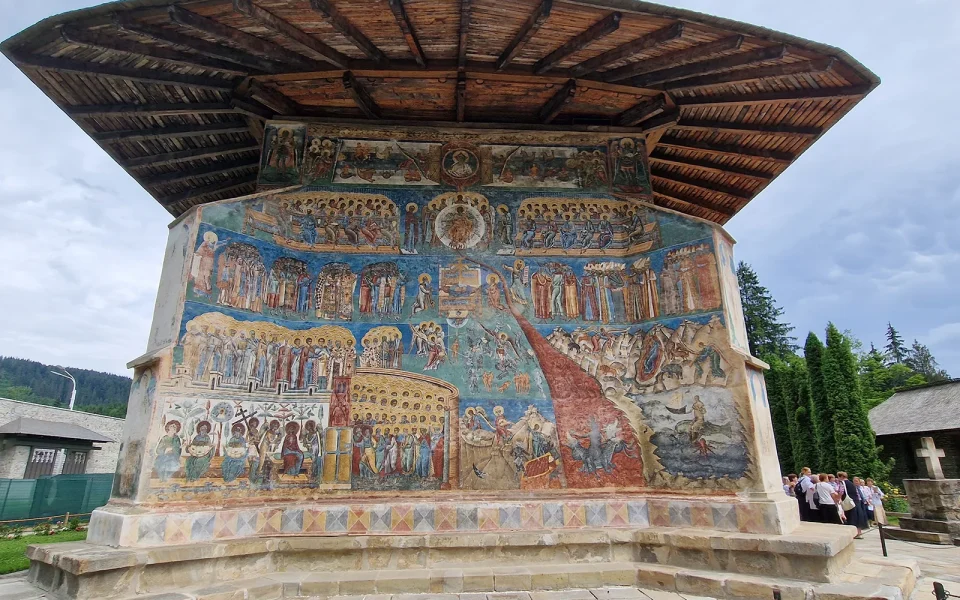
Voroneț Monastery
The most famous of the painted churches, and the one that gave a colour its name. Its west wall carries a Last Judgement painted across the…
Moldovița Monastery
Gold and deep blue, and a siege scene that is officially about the year 626 and unmistakably about 1453.
Putna Monastery
Stephen the Great's own foundation and his burial place. Not one of the painted churches — which is the first thing worth knowing about it.
Humor Monastery
The smallest and quietest of the main group, in reddish-brown rather than blue, with an open porch and a defensive tower beside it.
Suceava Fortress
The seat fortress of medieval Moldavia, on the ridge above Suceava. It held against Mehmed II — the sultan who had taken Constantinople twenty-three years earlier.
Marginea Black Pottery
A village where the pots come out of the kiln black, because the fire is starved of air on purpose. The workshops are working ones, not…