Voroneț Monastery
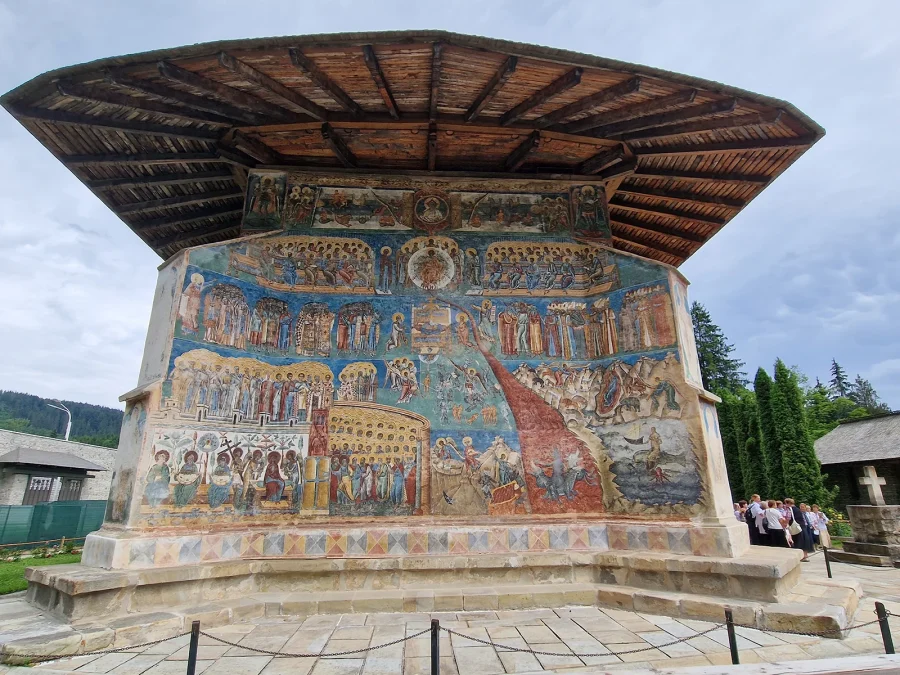
The most famous of the painted churches, and the one that gave a colour its name. Its west wall carries a Last Judgement painted across the entire face of the building.
- How long to allow
- About an hour
- Best for
- Anyone interested in medieval painting
The background
Voroneț is the church people mean when they say “the painted monasteries”. It was built in 1488 under Stephen the Great, and the exterior frescoes that made it famous came later — painted in the 1530s, during the reign of his successor Petru Rareș.
The west wall is the reason to come. It carries a Last Judgement covering the entire face of the building, read from the top down: the heavens rolled up like a scroll, the river of fire, the resurrection of the dead. It is the most complete composition of its kind in Moldavia, and it is on the outside of the building, where the congregation stood.
Voroneț blue
The background is an intense blue that entered the language: Romanian uses albastru de Voroneț the way art history uses Titian red. It has held its depth on an exposed wall through five centuries of Carpathian winters, which is the part that still gets studied.
The comparison you will hear from guides is “the Sistine Chapel of the East”. It is a fair description of the ambition and a misleading one about the setting: this is a small church in a village, and the paintings are outdoors.
What to know before you go
It is one of the eight churches inscribed by UNESCO, seven of them in 1993 and Sucevița added in 2010. Photography rules and service times are the monastery’s to set and they change; the community is a working one.
Prefer to have the route organised for you?
Guided private trips and custom itineraries are arranged externally, with a local driver-guide.
View private toursOther places near Suceava
Sucevița Monastery
The last of the painted churches and the most heavily fortified — a monastery inside real defensive walls, carrying a Ladder of Virtue thirty-two rungs high.
Moldovița Monastery
Gold and deep blue, and a siege scene that is officially about the year 626 and unmistakably about 1453.
Putna Monastery
Stephen the Great's own foundation and his burial place. Not one of the painted churches — which is the first thing worth knowing about it.
Marginea Black Pottery
A village where the pots come out of the kiln black, because the fire is starved of air on purpose. The workshops are working ones, not…
Humor Monastery
The smallest and quietest of the main group, in reddish-brown rather than blue, with an open porch and a defensive tower beside it.
Suceava Fortress
The seat fortress of medieval Moldavia, on the ridge above Suceava. It held against Mehmed II — the sultan who had taken Constantinople twenty-three years earlier.