Suceava Fortress
The seat fortress of medieval Moldavia, on the ridge above Suceava. It held against Mehmed II — the sultan who had taken Constantinople twenty-three years earlier.
- How long to allow
- One to two hours
- Best for
- Anyone who wants the political history behind the monasteries
The background
Suceava was the capital of Moldavia, and this is the fortress that made it one. Petru I Mușat moved the seat here from Siret at the end of the 14th century and built a fortified residence to hold it; the earliest firm documentary trace is from 1388.
Alexander the Good turned it into a residence proper. Stephen the Great turned it into a serious military problem for anyone approaching it — a deeper ditch, a thickened outer wall ring, added towers.
Why the walls are the point
In 1476 the fortress was besieged by Mehmed II, who had taken Constantinople in 1453 and whose artillery had settled the question there. At Suceava it did not. The fortress held, and the siege was abandoned.
That single fact explains a great deal about the rest of Bucovina. The monasteries an hour away were founded and painted by rulers who could afford to build, and they could afford to build because this hill was not taken.
What is there now
The site has been extensively restored, with the chapel preserved and parts of the wall circuit rebuilt, and it is laid out to be walked. Restoration work has continued in phases, so some areas can be fenced off.
Prefer to have the route organised for you?
Guided private trips and custom itineraries are arranged externally, with a local driver-guide.
View private toursOther places near Suceava
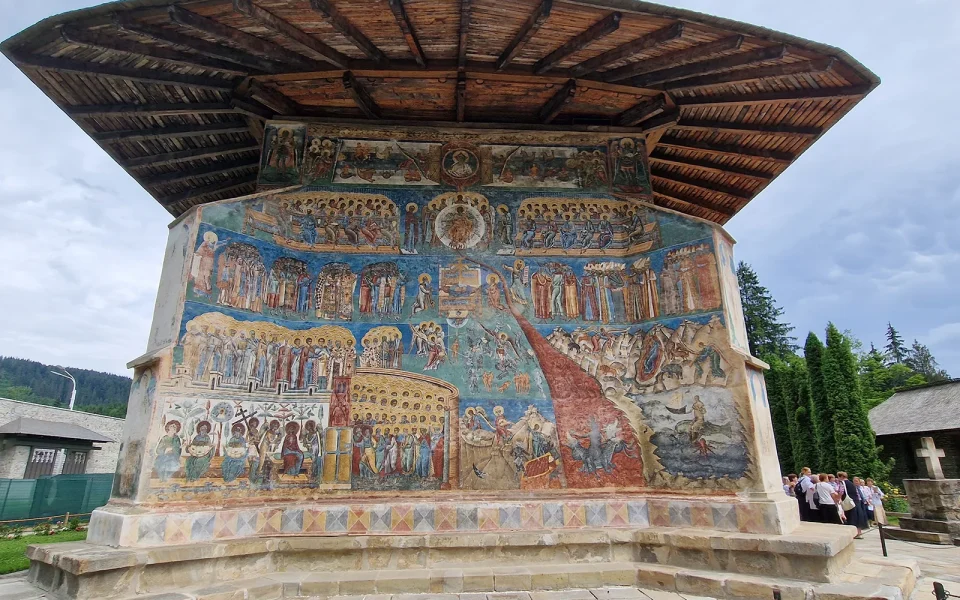
Voroneț Monastery
The most famous of the painted churches, and the one that gave a colour its name. Its west wall carries a Last Judgement painted across the…
Sucevița Monastery
The last of the painted churches and the most heavily fortified — a monastery inside real defensive walls, carrying a Ladder of Virtue thirty-two rungs high.
Moldovița Monastery
Gold and deep blue, and a siege scene that is officially about the year 626 and unmistakably about 1453.
Putna Monastery
Stephen the Great's own foundation and his burial place. Not one of the painted churches — which is the first thing worth knowing about it.
Marginea Black Pottery
A village where the pots come out of the kiln black, because the fire is starved of air on purpose. The workshops are working ones, not…
Humor Monastery
The smallest and quietest of the main group, in reddish-brown rather than blue, with an open porch and a defensive tower beside it.