Marginea Black Pottery
A village where the pots come out of the kiln black, because the fire is starved of air on purpose. The workshops are working ones, not demonstrations.
- How long to allow
- Half an hour to an hour
- Best for
- Anyone who would rather watch something being made than look at it in a case
The background
Marginea is a village between Rădăuți and Sucevița, and its pottery is black for a reason you can watch happening.
How the black is made
The clay is local and red. The vessels are thrown, dried, and fired in wood-fuelled kilns — and near the end of the firing the kiln is sealed, cutting off the air. Starved of oxygen, the fire pulls it out of the clay instead, and the iron in the body turns from red to a dense matte black. The same process drives smoke into the surface and leaves the finished pot harder than it would otherwise have been.
It is called reduction firing, and the decoration follows from it: no glaze and no paint, just burnishing and incised lines, spirals and concentric circles cut into the surface before the pot goes in.
What it is worth seeing for
The craft has been in the village for centuries and has been passed down inside families rather than taught in a school — by watching, which is also how a visitor picks up most of what is going on. The workshops sell what they make.
It is a short stop rather than a half day, and it goes naturally with Sucevița, which is up the same road.
Prefer to have the route organised for you?
Guided private trips and custom itineraries are arranged externally, with a local driver-guide.
View private toursOther places near Suceava
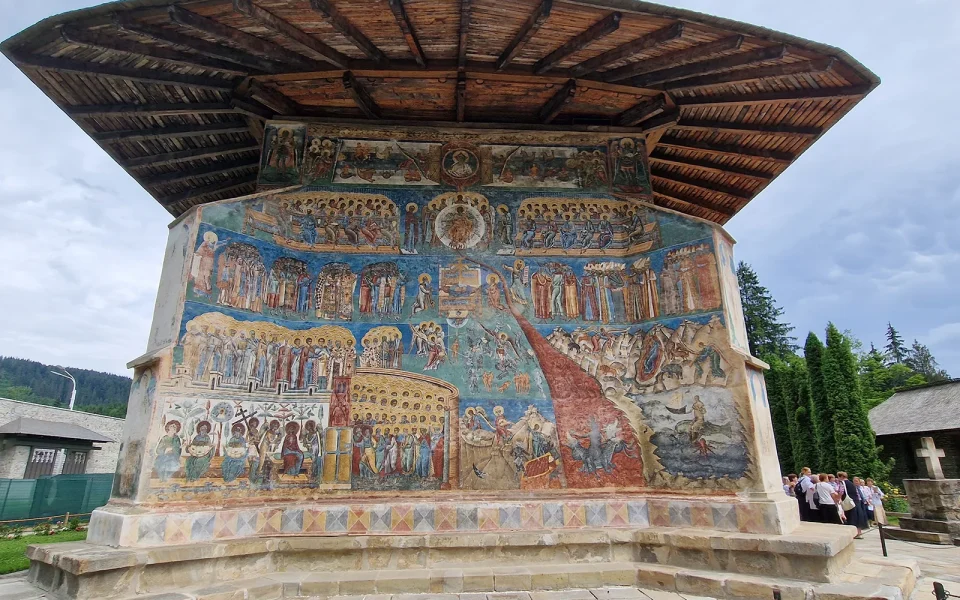
Voroneț Monastery
The most famous of the painted churches, and the one that gave a colour its name. Its west wall carries a Last Judgement painted across the…
Sucevița Monastery
The last of the painted churches and the most heavily fortified — a monastery inside real defensive walls, carrying a Ladder of Virtue thirty-two rungs high.
Moldovița Monastery
Gold and deep blue, and a siege scene that is officially about the year 626 and unmistakably about 1453.
Putna Monastery
Stephen the Great's own foundation and his burial place. Not one of the painted churches — which is the first thing worth knowing about it.
Humor Monastery
The smallest and quietest of the main group, in reddish-brown rather than blue, with an open porch and a defensive tower beside it.
Suceava Fortress
The seat fortress of medieval Moldavia, on the ridge above Suceava. It held against Mehmed II — the sultan who had taken Constantinople twenty-three years earlier.