Putna Monastery
Stephen the Great's own foundation and his burial place. Not one of the painted churches — which is the first thing worth knowing about it.
- How long to allow
- An hour
- Best for
- Anyone who has been to the painted monasteries and wants the politics behind them
The background
Putna was founded by Stephen the Great in 1466 and consecrated in 1469, and he is buried in it. So are his son Bogdan III and his grandson Ștefăniță, which makes it the dynastic necropolis of the house that built most of what is now on the UNESCO list.
Set expectations first
Putna is not a painted monastery. Visitors arriving after Voroneț and Sucevița sometimes expect one and are briefly disappointed, which is an avoidable disappointment: the church standing today is a later rebuilding, and its exterior does not carry the fresco cycles the painted churches are famous for.
What it has instead is the tomb, and the treasury — embroideries, manuscripts and metalwork of a quality that explains what a 15th-century Moldavian court could commission.
Why come anyway
Because it is the source of the rest. Stephen ruled for nearly half a century, founded churches across Moldavia including Voroneț, and held the principality together against the Ottomans long enough for all of it to be built. Standing at his grave puts the monasteries an hour away into an order that a guidebook list does not.
Opening times and tickets
We do not publish opening hours or prices, because they change and a wrong time here is worse than none. The operator keeps the current details.
Official websitePrefer to have the route organised for you?
Guided private trips and custom itineraries are arranged externally, with a local driver-guide.
View private toursOther places near Suceava
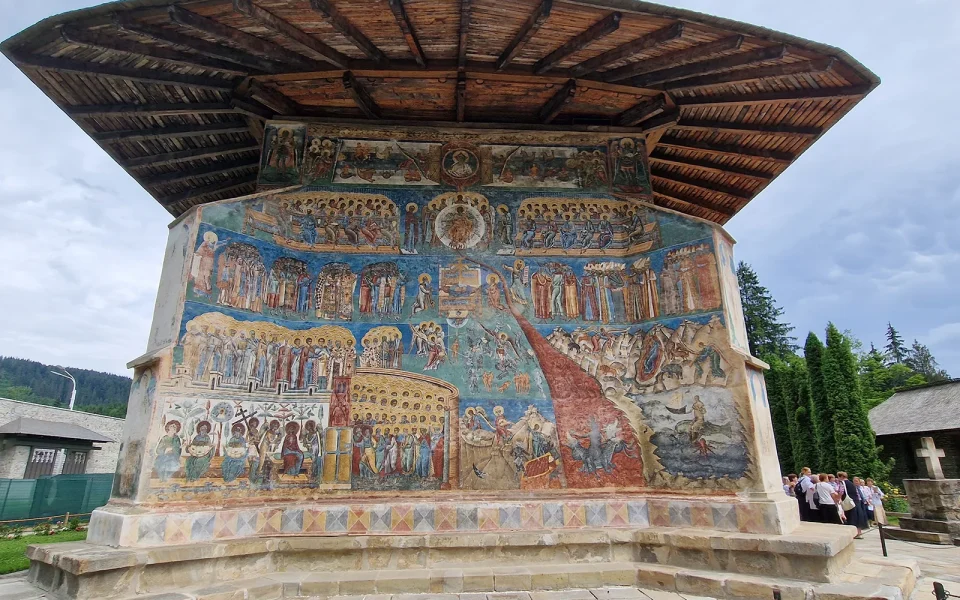
Voroneț Monastery
The most famous of the painted churches, and the one that gave a colour its name. Its west wall carries a Last Judgement painted across the…
Sucevița Monastery
The last of the painted churches and the most heavily fortified — a monastery inside real defensive walls, carrying a Ladder of Virtue thirty-two rungs high.
Moldovița Monastery
Gold and deep blue, and a siege scene that is officially about the year 626 and unmistakably about 1453.
Humor Monastery
The smallest and quietest of the main group, in reddish-brown rather than blue, with an open porch and a defensive tower beside it.
Suceava Fortress
The seat fortress of medieval Moldavia, on the ridge above Suceava. It held against Mehmed II — the sultan who had taken Constantinople twenty-three years earlier.
Marginea Black Pottery
A village where the pots come out of the kiln black, because the fire is starved of air on purpose. The workshops are working ones, not…