Bucovina & Painted Monasteries
Monastery walls painted on the outside, in the open air, five hundred years ago — and still legible. There is nothing else quite like this in Europe, and it is worth the drive north.
The ones worth planning around
What there is to visit
Everything published in Bucovina & Painted Monasteries, filterable by what you are interested in.
Moldovița Monastery
Gold and deep blue, and a siege scene that is officially about the year 626 and unmistakably about 1453.
Sucevița Monastery
The last of the painted churches and the most heavily fortified — a monastery inside real defensive walls, carrying a Ladder of Virtue thirty-two rungs high.
Voroneț Monastery
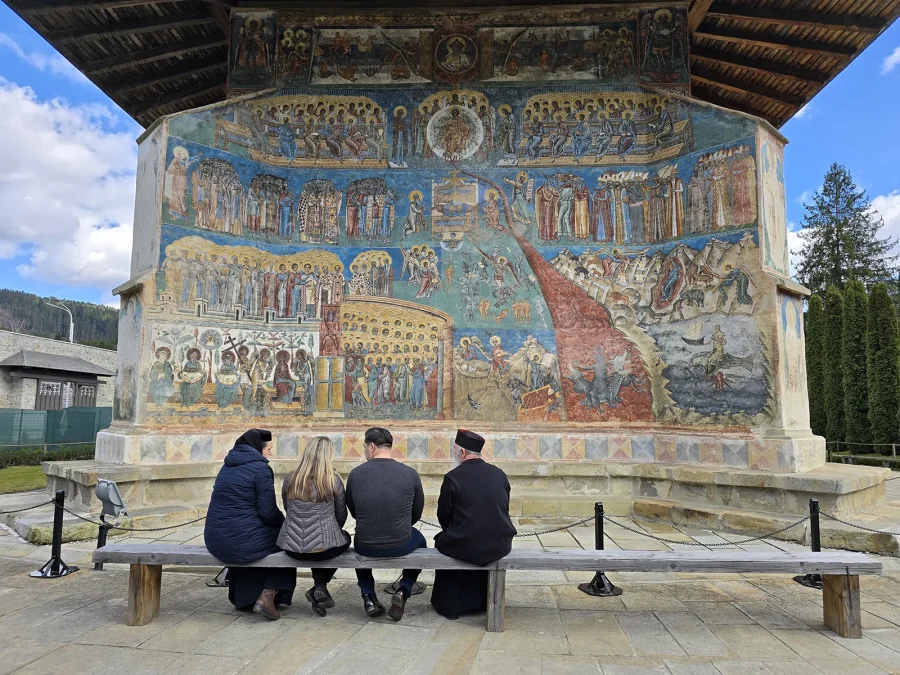
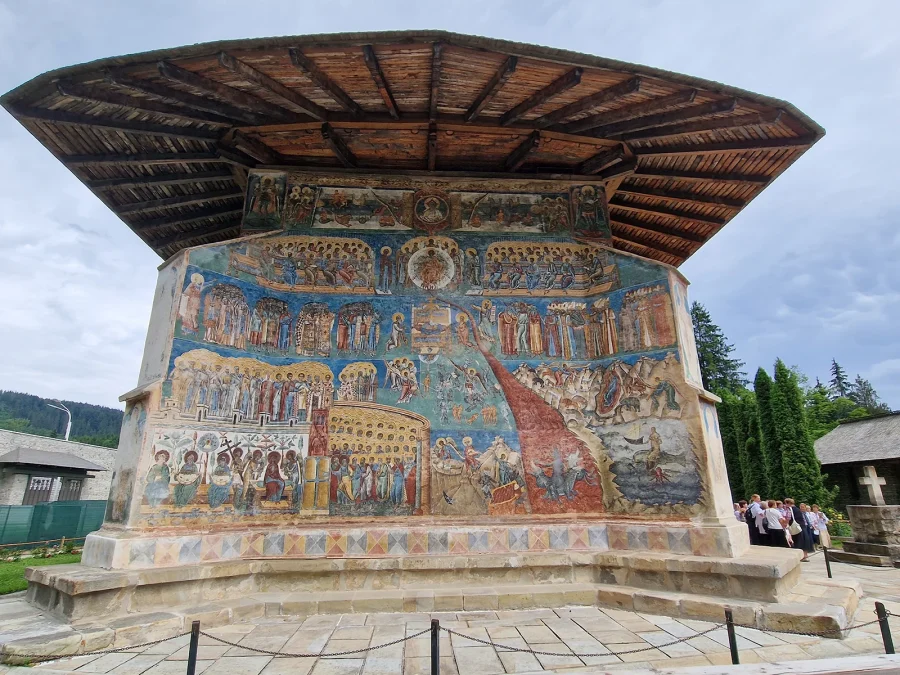
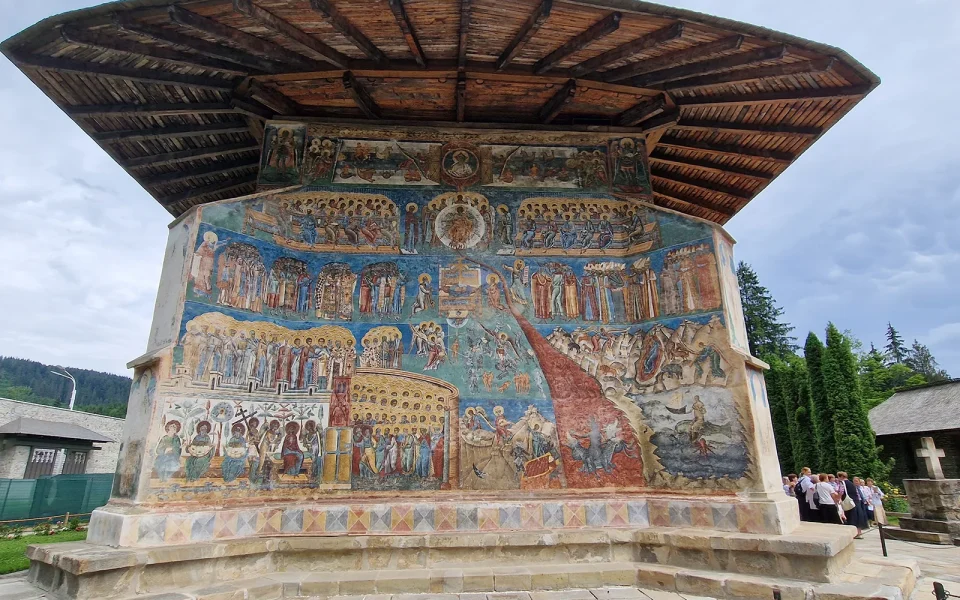
The most famous of the painted churches, and the one that gave a colour its name. Its west wall carries a Last Judgement painted across the…
Humor Monastery
The smallest and quietest of the main group, in reddish-brown rather than blue, with an open porch and a defensive tower beside it.
Marginea Black Pottery
A village where the pots come out of the kiln black, because the fire is starved of air on purpose. The workshops are working ones, not…
Putna Monastery
Stephen the Great's own foundation and his burial place. Not one of the painted churches — which is the first thing worth knowing about it.
Suceava Fortress
The seat fortress of medieval Moldavia, on the ridge above Suceava. It held against Mehmed II — the sultan who had taken Constantinople twenty-three years earlier.
Where to base yourself
Towns and cities worth staying in rather than passing through.
The background
Bucovina sits in the north-east, in Suceava county, and it is the one region in Romania people travel to for a single reason. The painted monasteries are not decorated churches. They are buildings whose entire exterior surface was frescoed, in the sixteenth century, and left outdoors ever since.
What makes them unusual
Interior frescoes are common across the Orthodox world. Exterior ones, covering every outside wall from the foundation to the eaves, are not — and nowhere else has a concentration of them at this quality. They were painted for a congregation that largely stood outside, and they work as a wall of narrative: biblical scenes, the lives of the saints, the Last Judgement laid out in registers you can read standing in the grass.
That they survive at all is partly the mineral pigments and partly the local weather, which is mild and misty rather than harsh.
The UNESCO listing
They are inscribed as Churches of Moldavia. Seven were listed in 1993; the Church of the Resurrection at Sucevița was added in 2010, making eight.
The four most people visit
Voroneț is the famous one, built in 1488 under Stephen the Great. Its frescoes are dominated by an intense blue that has been known for centuries as Voroneț blue, and whose composition has never been satisfactorily reproduced.
Humor was built in 1530 and painted in 1535, and reads red where Voroneț reads blue.
Moldovița followed in 1532, painted in 1537, under Petru Rareș. Its frescoes have changed remarkably little.
Sucevița is the last and the largest, founded in 1581 and painted between 1602 and 1604, with ramparts and turrets that make it read as a fortress before it reads as a monastery.
How to do it
They are spread across a rural area rather than clustered in a town, so this is a driving region. Two days is comfortable for the four above. One day is possible and rushed, and rushing rather defeats the point of standing in front of a wall reading it.
Other parts of Romania
Fit this into a trip
The itineraries show how the regions connect — which cities work as a base, what fits in three days, and where a longer trip is worth it.
Prefer to have the route organised for you?
Guided private trips and custom itineraries are arranged externally, with a local driver-guide.
View private tours